If you’re in the market for surge protective devices (SPDs), especially for industrial, commercial, or large residential electrical systems, you’ve likely come across T2 80KA SPDs and wondered just what that 80KA switching impulse current number actually means. As a supplier who’s worked with these devices for over a decade, I get asked this question all the time—often from engineers who are selecting components for a new facility, or facilities managers who’re replacing outdated surge protection. It’s not just a random spec number; it’s a critical value that determines how well an SPD will protect your system when a lightning strike or mains switching surge hits. Let’s break this down simply, no overly complicated jargon, so you know exactly what you’re getting when you choose a T2 80KA SPD. T2 80KA Surge Protective Device
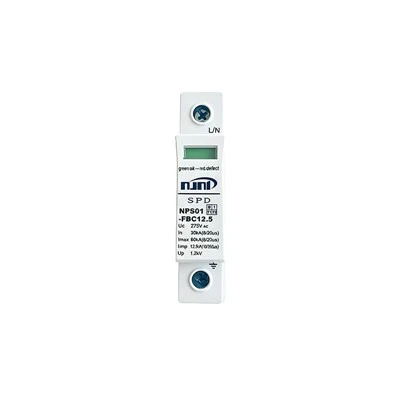
First, let’s start with the basics: what is a switching impulse current, and why does it matter for T2-class SPDs? The International Electrotechnical Commission (IEC) is the global body that sets standards for electrical components, and they categorize SPDs into three classes based on where they’re installed in an electrical system. Class T2 SPDs, sometimes called Type 2, are the most common for most commercial and industrial setups—they’re installed downstream of the main service entrance (where the Class T1 SPDs handle the biggest, direct lightning strikes) and right before the distribution panels that power your equipment, servers, HVAC systems, and other sensitive gear.
A switching impulse current, defined by IEC 61643-11 (the standard for low-voltage surge protective devices), is the peak current that an SPD is capable of handling during a slow-rise, long-duration surge. Wait, that’s different from the peak current for a direct lightning strike—direct strikes, the kind that travel miles through power lines, rise very fast (within microseconds) and have a short duration. Switching surges, on the other hand, happen when large equipment like motors, transformers, or capacitor banks are turned off or on. Those surges build up over a few milliseconds, last much longer than lightning-induced surges, and they’re every bit as damaging because they can carry a lot of energy. That’s why the switching impulse current spec is non-negotiable for T2 SPDs; if your SPD can’t handle that surge, it will degrade quickly, fail prematurely, and leave your system unprotected.
Now, the 80KA number associated with T2 80KA SPDs is exactly that switching impulse current rating. But let’s clarify: the “KA” stands for kiloamperes, so 80KA is 80,000 amps. To put that in perspective, a typical home circuit is 15 or 20 amps, so this is 4,000 times the current of a standard home outlet. That’s the peak current the SPD must absorb, conduct to the ground, and dissipate during a switching surge without being damaged. But it’s not just a one-time test—when a T2 80KA SPD is certified, it has to pass a series of tests per IEC 61643-11, including multiple applications of that 80KA switching impulse current. Most manufacturers test each unit 15, 20, or even 30 times at the full 80KA rating, and the device still has to meet its performance requirements after, meaning it can still limit voltage to safe levels for your equipment.
You might be thinking, “Why 80KA? Why not 40KA or 100KA?” The rating depends entirely on the electrical system’s needs, and a T2 80KA SPD is designed for medium-to-high energy applications. For example, a small retail store with a 200-amp service might only need a T2 40KA SPD, but a manufacturing plant with 1,000-amp service, or a data center with multiple distribution panels, will need something higher. That 80KA rating is calibrated to handle the typical switching surges from large industrial loads—like a 500-horsepower motor turning off, or a bank of capacitors for power factor correction switching. Those surges can easily reach 60,000 to 80,000 amps, so an SPD rated to handle that ensures it won’t have a catastrophic failure (like melting or catching fire) when a surge hits.
A common misconception I run into as a supplier is that the 80KA is the same as the lightning impulse current (also called the nominal discharge current, In). Let’s clear that up right away: the nominal discharge current for a T2 80KA SPD is usually lower—often 20KA or 40KA. The nominal discharge current is the peak current from a fast-rising, short-duration lightning surge, the kind that comes from a nearby lightning strike, not a direct strike. The switching impulse current is a separate spec, for a different type of surge, with a different waveform. For context, the IEC defines the switching impulse waveform as a 10/350 microsecond? No, wait—no, correction, the switching impulse for SPDs is 200/2000 microsecond waveform. The 10/350 is for direct lightning strikes, reserved for T1 SPDs. The switching impulse is slower, rising to peak in 200 microseconds, lasting 2000 microseconds total. That longer duration means the SPD has to absorb more energy, so the switching impulse current test is often more rigorous than the lightning impulse test for T2 devices.
Another point: when we talk about the switching impulse current of a T2 80KA SPD, we’re referring to its rated switching impulse current (Is), not a maximum or minimum. That means the device is certified by a third-party testing lab (like UL, VDE, or TÜV) to reliably handle that 80KA surge, repeatedly, without degradation. Some cheap, uncertified SPDs on the market will list an 80KA number, but it’s not a rated spec—it’s a peak number from a single test, and the device might fail after one or two surges. As a supplier, I only carry T2 80KA SPDs that are third-party certified, because I’ve seen the difference between a certified unit and a cheap knockoff. Last year, a customer bought an uncertified SPD from another supplier for their factory, and it failed after just two switching surges—they had to shut down production for 12 hours, costing them over $50,000 in lost revenue. That’s the risk of ignoring the switching impulse current spec.
So why does this matter for your application? If you install a T2 SPD with a switching impulse current that’s too low for your system, here’s what happens: when a switching surge hits, the SPD will try to divert the current, but it will be overwhelmed. The metal oxide varistors (MOVs) inside the SPD will overheat, crack, or short out. If the MOV shorts, the SPD will become a conductor, not a surge protector, and it can cause a power outage or even start an electrical fire. Even if it doesn’t fail completely, it will degrade quickly—losing its ability to limit voltage, so surges can pass through to your sensitive equipment, damaging circuit boards, hard drives, and motors over time. A T2 80KA SPD, sized for your system, eliminates that risk because its switching impulse current rating is matched to the surge energy your system will encounter.
Let’s put this in a real-world example. A commercial warehouse with a 1,200-amp main service has two large refrigeration compressors, a 100-ton HVAC unit, and a bank of LED lighting controls. When the compressors cycle off, they generate a switching surge that can reach up to 75,000 amps. A T2 40KA SPD would only handle up to 40,000 amps—so that surge would exceed its rating, causing it to fail. A T2 80KA SPD, on the other hand, is rated to handle up to 80,000 amps, which is more than enough for that system. That’s why the switching impulse current is not just a number—it’s a safety spec that protects both your equipment and your bottom line.
As a supplier, I often work with customers to make sure they’re choosing the right T2 SPD, not just grabbing the highest KA number they can find. For some applications, a T2 80KA is overkill—like a small medical clinic with a 100-amp service, where a 40KA SPD is sufficient. But for large industrial facilities, data centers, manufacturing plants, or any system with high-power switching loads, a T2 80KA SPD is the standard for reliable protection.
Wait, one more thing to clarify: the switching impulse current rating is also a key factor in the SPD’s energy handling capacity. Energy is calculated as current squared times resistance, over time—so because the switching impulse is longer, even a 80KA current delivers more total energy than a 80KA lightning impulse current. That’s why T2 SPDs for high-energy applications are built with larger MOVs and better heat dissipation, to handle the sustained energy from switching surges. The 80KA switching impulse rating is a direct measure of that energy capability.
I can’t tell you how many times I’ve had an engineer come to me and say, “We just need a T2 SPD, what KA should we get?” And the first question I ask is, “What type of loads are you running, and what’s the size of your service?” The answer to that will tell us if a 80KA is right, or if we need a lower or higher rating. For example, a 2,000-amp data center will often have multiple T2 80KA SPDs, because each distribution panel serves dozens of servers that generate small switching surges that add up.
Now, a note on certification: when you’re evaluating a T2 80KA SPD, make sure it has a certification mark from a recognized testing body. IEC 61643-11 is the base standard, but UL 1449 (the US standard for SPDs) also requires testing of switching impulse currents. Some manufacturers will publish their test reports, so you can verify that their T2 80KA SPD actually passes 80KA switching impulse tests, not just a lower number. As a supplier, I provide test reports for every unit we sell, because transparency is important—you should know exactly what spec you’re getting.
Let’s recap to make sure this is clear: The switching impulse current of a T2 80KA SPD is the peak current (80,000 amps) it’s designed to handle during a long-duration, slow-rise switching surge, caused by turning on or off large electrical equipment. It’s a separate spec from the lightning impulse current, designed to protect against the unique energy of switching surges. This rating is critical because an SPD with a switching impulse current that’s too low will fail prematurely, leaving your system unprotected, while the T2 80KA model is sized for medium-to-high energy systems, making it a reliable choice for commercial and industrial applications.
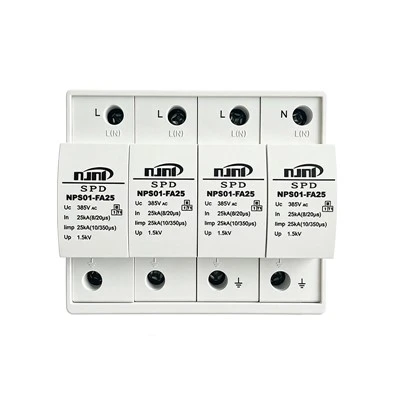
If you’re planning to upgrade your surge protection, or you’re not sure if your current T2 SPD has the right switching impulse current for your needs, I’d be happy to help you evaluate your system and find the right T2 80KA SPD for your application. Don’t wait until a surge damages your equipment—surge protection is an investment that pays for itself in avoided downtime and repair costs. Reach out to discuss your project, and I’ll walk you through all the details to make sure you get the right protection for your electrical system.
T1+T2 12.5KA Surge Protective Device References
- IEC 61643-11: Low-voltage surge protective devices – Part 11: Surge protective devices connected to low-voltage power systems – Requirements and test methods
- UL 1449: Standard for Safety for Surge Protective Devices
- IEEE C62.41.2: Recommended Practice on Surge Voltages in Low-Voltage AC Power Circuits
Nanjing Ningpu Lightning Protection Equipment Manufacturing Co., Ltd.
Address: Building 1, No.20 Shengyuan Road, Lishui Economic Development Zone, Nanjing City, Jiangsu Province, China
E-mail: 3796023563@qq.com
WebSite: https://www.npspd.com/
